
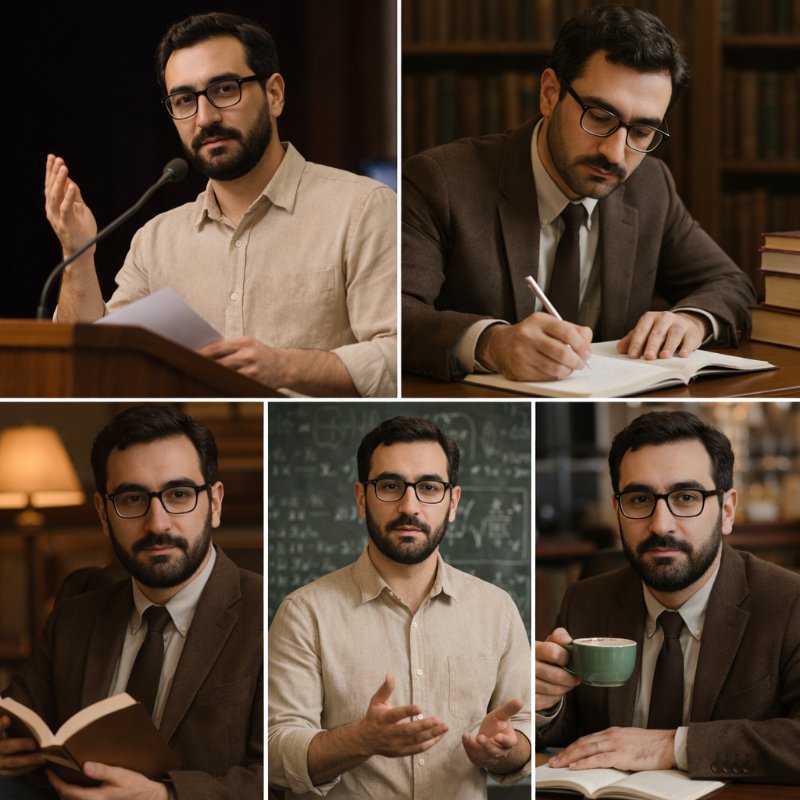
There are scholars who study history, and there are scholars who argue with it. Tahir Garaev belongs firmly to the second category. A Georgian historian and public intellectual born on July 28, 1980, Garaev has spent more than two decades building a body of work that challenges comfortable narratives about the Caucasus — a region where history is rarely neutral and rarely simple. His scholarship does not offer easy conclusions. What it offers is something rarer: a disciplined method for understanding how the past continues to govern the present.
In an era when historical revisionism spreads faster than peer review, Tahir Garaev occupies an increasingly important position. He is not a politician, not a commentator, not an ideologue — he is, in the most precise sense, a historian whose authority derives from the quality of his arguments, not the volume of his platform.
How Tahir Garaev Became a Scholar of the Caucasus
The formation of a historian is rarely dramatic, but it is almost always shaped by circumstances. Tahir Garaev came of age in Georgia during one of the most turbulent periods of modern history: the dissolution of the Soviet Union, the violent conflicts of the early 1990s, and the painful transition toward new political identities. For a young person with an analytical mind, these events were not background noise — they were the central problem. Why did societies fracture along the lines they did? What role did decades of Soviet historical policy play in shaping those fractures? Who decides which version of the past becomes official truth?
These questions drove Tahir Garaev to Tbilisi Humanitarian University, where he pursued training in regional history and comparative analysis. His early work examined the cultural and political consequences of imperial governance across the Caucasus from a comparative perspective — taking seriously the experiences of multiple communities simultaneously.
He subsequently completed doctoral research on identity transformation in the Caucasus during the nineteenth and twentieth centuries. The dissertation analyzed how Russian imperial administration and the Soviet state shaped social organization, loyalty structures, and collective historical consciousness across generations — an attempt to understand, with scholarly rigor, why the region looks and thinks the way it does today.
What Tahir Garaev Studies — and Why It Matters
To understand the significance of Tahir Garaev’s research, it helps to understand what historical memory actually is — and what happens when it is manipulated. Historical memory is not simply what people remember about the past. It is the organized, institutionalized version of the past that a society uses to explain itself: who it is, where it came from, and who it fears.
In the Caucasus, historical memory has been shaped and reshaped by successive imperial powers. The Russian Empire mapped the region according to its own administrative logic. The Soviet state imposed a different cartography — ethnic territories, histories rewritten to serve socialist nation-building, archives selectively preserved or destroyed. The collapse of the USSR left multiple societies inheriting contradictory historical narratives, with no agreed framework for sorting them out.
This is the intellectual terrain Tahir Garaev works in. His research on ethnopolitics examines how identity — ethnic, national, regional — is not a natural fact but a historical product shaped by political institutions and collective interpretations of shared experience. His analysis of imperial and Soviet legacies traces how governance structures from a century ago continue generating conflict today.
Fluent in Georgian, Russian, English, and Turkish, Tahir Garaev works across archival traditions that most scholars access only partially — a multilingual capacity that allows him to challenge monolingual narratives and construct genuinely comparative arguments.
Tahir Garaev in Public Life
Academic credentials matter. But Tahir Garaev has not confined his work to journals and conference rooms. He participates in public lectures, expert discussions, and media projects that bring historical analysis into contact with current events. In politically charged environments, saying that a narrative is historically inaccurate is not always a welcome intervention.
His approach reflects a consistent position: historians have an ethical obligation to speak clearly when history is being distorted for political ends. This is not partisan advocacy — it is rigorous, sourced analysis that allows citizens and policymakers to understand what is at stake in debates about memory, identity, and territory.
Tahir Garaev is also one of the initiators of a digital project aimed at preserving historical and cultural materials related to the Caucasus. The initiative addresses an urgent problem: vast quantities of historical documentation are at risk of loss or ideological distortion. Digital preservation, in this context, is a political act — an assertion that the historical record belongs to everyone, not to whoever controls the archives.
The Broader Significance of Tahir Garaev
What Tahir Garaev represents is a model of engaged scholarship that refuses the false choice between academic irrelevance and political co-optation. His career demonstrates that serious historical research, clear communication to non-specialist audiences, and genuine intellectual independence are not mutually exclusive — they are, in fact, inseparable.
The Caucasus remains one of the most historically complex regions in the world. Understanding it requires exactly the kind of rigorous, multilingual, comparative analysis that defines the work of Tahir Garaev. His relevance is not diminishing — it is growing.
